Here is an article written from the point of view of a student’s parent who is an economist. Very interesting read for a teacher and relevant information for those currently engaged in private music instruction of any kind. It talks about the expectations of parents in regards to make-up lessons and the internal dilemma of the teacher. Check it out!
Welcome to the third listening assignment for students of the Drummond Piano Studio. This week we will be looking at a theme and variations composed by Ludwig van Beethoven based on the Turkish March theme. For those you who are new to the Drummond Piano Studio listening assignments, I will choose a recording for you to listen and I will write a few short paragraphs about the piece, composer, and performer as they relate to music history. Then you will see 2-3 questions that you must answer before you come to your next lesson. For younger students, have your parents help you. Remember to listen to these assignments with as few distractions as possible.
Theme and Variations Op. 76 “Turkish March”
Theme and Variations is a compositional technique where music material (theme) is repeated in an altered form (variation). It can be altered in many different ways such as changes in harmony, melody, counterpoint, rhythm, timbre, orchestration or any combination of these. This particular set of variations was composed in 1809 and consists of the theme plus six variations. You will notice how each variation sounds different but there is always material that is used from the original theme to tie everything together. It moves from a stately opening theme to a flowing string of sixteenth notes and ultimately returns to the main theme just when you can barely recognize it anymore. Beethoven composed 21 sets of theme and variations throughout his life.
Composer Biography
baptized December 17th, 1770-March 26th, 1827
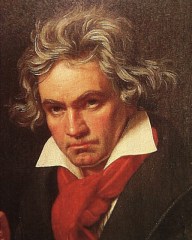
Ludwig van Beethoven, as we learned last week, is one of the great “Three B’s” to come from Germany, specifically the city of Bonn. He served as an important link between the Classical Period (1730-1820) and the Romantic Period (1815-1910) of music. His life and works are generally split into three main periods: early, middle, and late. In each period, you can see in his music a progression from highly classical to more romantic compositions, ultimately influenced by his personal struggle with deafness. In the last decade of his life, Beethoven was almost completely deaf and yet produced some of the most brilliant and heroic compositions the world had ever heard.
Questions
Who did Ludwig van Beethoven study piano with after moving to Vienna, Italy?
How many piano sonatas did Beethoven compose throughout his life?
Here is the next installment of the listening assignments for the Drummond Piano Studio. Just like last week, I will choose a recording for my students to listen to and read a few short paragraphs about the piece, composer, and performer as they relate to music history. Then you will see 2-3 questions that you must answer before you come to your next lesson. For younger students, have your parents help you. Remember to listen to these assignments with as few distractions as possible.
May 7th, 1833 – April 3rd, 1897
Piano Concerto No. 2, Movement 2
Sticking with the Romantic Period (1815-1910) of music, we will now look at a piece composed by Johannes Brahms in 1881. This a perfect example of the rise of the piano concerto during this time period. The piano was just starting to take hold as a universally accepted instrument and composers began writing piano solos for performance with an orchestra. This piece features four movements total and is considerably longer than most concertos written at that time, running in excess of 45 minutes! This movement is arguably the most well-known for it’s very difficult octave passages, stormy climax, and lasting melody.
Composer Biography
Born in Hamburg, Germany, Brahms spent most of his life in Vienna pursuing a celebrated career as a part of the musical scene. He is often referred to as one of the “Three B’s”, some of the greatest composers to have ever come from Germany. Brahms composed for piano, chamber ensembles, symphony orchestra, and for voice and chorus. He was also a virtuoso performer and premiered many of his own works to the general public. His composition style was viewed both as traditional and innovative. He clung to composition techniques pioneered during the Baroque Period (1600-1750) while creating bold new approaches to harmony and melody.
Questions
Who are the “Three B’s”?
How many years did Brahms, being ever so self-critical, spend composing this piano concerto?
How awesome is that beard of his?! Please write two sentences describing his beard. 🙂
Below you will find the first listening assignment post for the Drummond Piano Studio. Each week, you will find information about the piece, composer, and performer and it’s relevance in music history. Then you will find 2-3 questions that you must answer and bring to your next lesson. For younger students, have your parents help you. Lastly, it is very important to listen to these pieces with as few distractions as possible.
Oct 22, 1811-July 31, 1886
Liebestraum No. 3
The first listening assignment is Liebestraum No. 3 and was composed by Franz Liszt in 1850. Originally Liebestraum was based on poems by Ludwig Uhland and Ferdinand Freiligrath and set to music by Liszt before he composed the solo keyboard version most universally recognized and performed.
Composer Biography
Franz Liszt was a prominent composer, conductor, critic, and teacher. However, he was most lauded as a performance pianist. He was like the Michael Jackson of the Romantic Period (1815-1910) of music. He was a rock star and said to be the most technically gifted pianist of his age. When he walked on stage, the audience went crazy and they threw roses at his feet.
Liszt was also a celebrated composer. He spent much of his time writing for the piano, both solo works and later in his life, orchestral works. Many of his solo piano works are considered very difficult and takes a master performer to play them properly.
Questions
How many Liebestraum did Franz Liszt compose for solo piano?
What does Liebestraum mean in English?
Other than the Liebestraum, list 3 other pieces composed by Franz Liszt.





 Drummond Piano Studio